
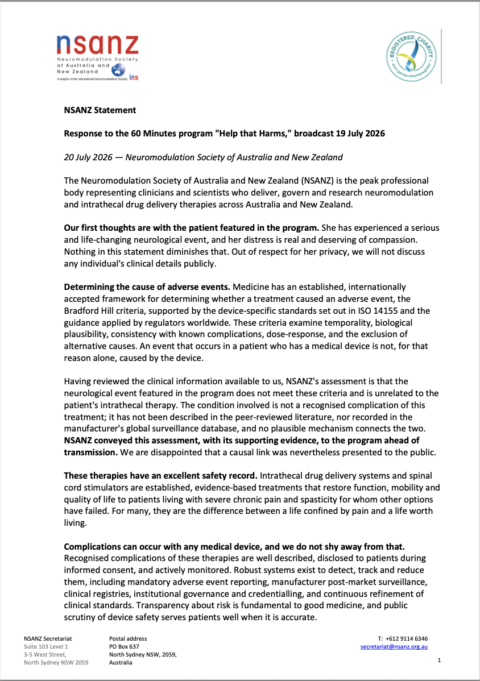
NSANZ Statement
Response to the 60 Minutes program “Help that Harms,” broadcast 19 July 2026
20 July 2026 — Neuromodulation Society of Australia and New Zealand
The Neuromodulation Society of Australia and New Zealand (NSANZ) is the peak professional body representing clinicians and scientists who deliver, govern and research neuromodulation and intrathecal drug delivery therapies across Australia and New Zealand.
Our first thoughts are with the patient featured in the program. She has experienced a serious and life-changing neurological event, and her distress is real and deserving of compassion. Nothing in this statement diminishes that. Out of respect for her privacy, we will not discuss any individual’s clinical details publicly.
Determining the cause of adverse events. Medicine has an established, internationally accepted framework for determining whether a treatment caused an adverse event, the Bradford Hill criteria, supported by the device-specific standards set out in ISO 14155 and the guidance applied by regulators worldwide. These criteria examine temporality, biological plausibility, consistency with known complications, dose-response, and the exclusion of alternative causes. An event that occurs in a patient who has a medical device is not, for that reason alone, caused by the device.
Having reviewed the clinical information available to us, NSANZ’s assessment is that the neurological event featured in the program does not meet these criteria and is unrelated to the patient’s intrathecal therapy. The condition involved is not a recognised complication of this treatment; it has not been described in the peer-reviewed literature, nor recorded in the manufacturer’s global surveillance database, and no plausible mechanism connects the two. NSANZ conveyed this assessment, with its supporting evidence, to the program ahead of transmission. We are disappointed that a causal link was nevertheless presented to the public.
These therapies have an excellent safety record. Intrathecal drug delivery systems and spinal cord stimulators are established, evidence-based treatments that restore function, mobility and quality of life to patients living with severe chronic pain and spasticity for whom other options have failed. For many, they are the difference between a life confined by pain and a life worth living.
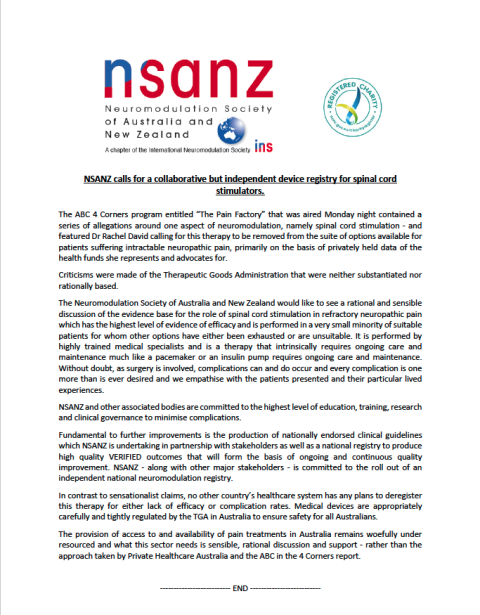
NSANZ calls for a collaborative but independent device registry for spinal cord stimulators.
11 April 2024
The ABC 4 Corners program entitled “The Pain Factory” that was aired Monday night contained a series of allegations around one aspect of neuromodulation, namely spinal cord stimulation – and featured Dr Rachel David calling for this therapy to be removed from the suite of options available for patients suffering intractable neuropathic pain, primarily on the basis of privately held data of the health funds she represents and advocates for.
Criticisms were made of the Therapeutic Goods Administration that were neither substantiated nor rationally based.
The Neuromodulation Society of Australia and New Zealand would like to see a rational and sensible discussion of the evidence base for the role of spinal cord stimulation in refractory neuropathic pain which has the highest level of evidence of efficacy and is performed in a very small minority of suitable patients for whom other options have either been exhausted or are unsuitable. It is performed by highly trained medical specialists and is a therapy that intrinsically requires ongoing care and maintenance much like a pacemaker or an insulin pump requires ongoing care and maintenance. Without doubt, as surgery is involved, complications can and do occur and every complication is one more than is ever desired and we empathise with the patients presented and their particular lived experiences.
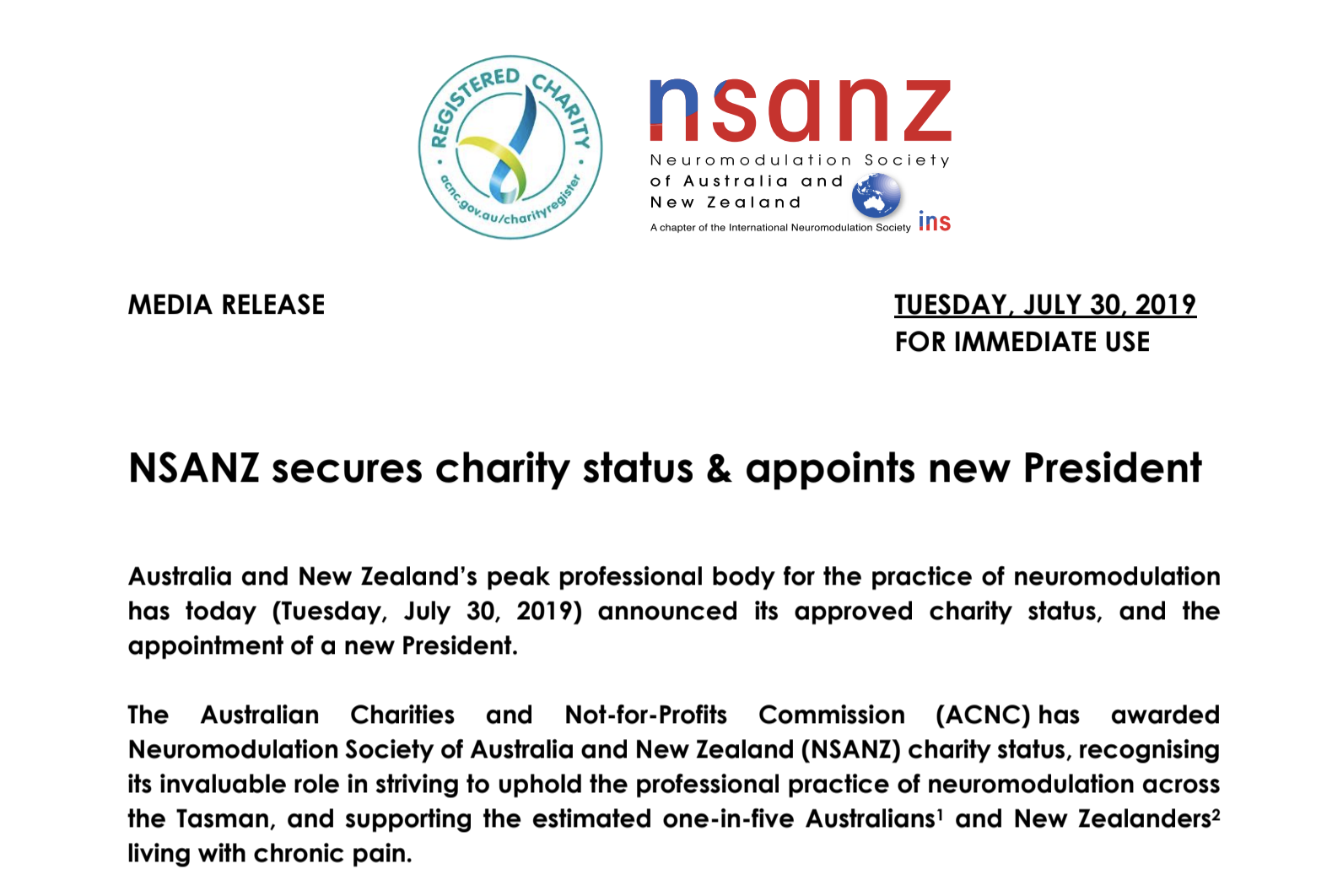
NSANZ Secures charity status and appoints new President
Australia and New Zealand’s peak professional body for the practice of neuromodulation has today (Tuesday, July 30, 2019) announced its approved charity status, and the appointment of a new President.
One million Aussies with chronic pain worse off under Government’s Private Health insurance changes
Existing health fund holders forced to upgrade or miss out on treatment options
The new Private Health Insurance (PHI) policy changes will make access to effective chronic pain treatment through private hospitals inaccessible for one-in-two current PHI policy holders. This could amount to well over a million individuals with chronic pain.
Opioid crisis set to soar under Government’s Private Health Insurance (PHI) changes
Chronic pain patients to be denied access to existing life-changing treatment options.
The new Private Health Insurance (PHI) policy changes have reignited concerns over Australia’s opioid epidemic, with Australians denied access to life-changing pain management treatments unless they hold the top-tier Gold policy.
